
Ten months after the less healthy food ad restrictions came in, the rules underneath them are already up for debate.
This month, 26 businesses and trade bodies wrote to the Prime Minister asking him to press pause on a change to how “less healthy” food is defined. Health campaigners are urging the Government to do the opposite, and quickly. Whichever side wins, food and drink marketers will feel it.
What’s being proposed
Every HFSS rule rests on one test: the Nutrient Profiling Model (NPM). It decides which products fall under the TV and online ad restrictions, the multibuy ban and the in-store placement rules.
The model in use today dates from 2004/05. An updated version was developed in 2018. It puts more weight on free sugars and gives more credit for fruit, vegetables and fibre. The Department of Health and Social Care consulted earlier this year on applying it to the ad restrictions. That could bring products such as yoghurts, some desserts, breakfast cereals and cereal bars into scope.
 The industry’s case: press pause
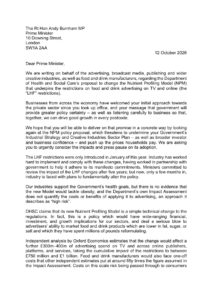
The letter to the Prime Minister, coordinated by the Advertising Association, is signed by brands including Coca-Cola, Mars, KFC and Asda, broadcasters including ITV, Channel 4 and Sky, and bodies including ISBA, the IPA and the IAB. Their arguments:
- It’s too soon. Ministers committed to review the restrictions after five years. Changing them a few months in is, they say, “poor regulatory practice”.
- Reformulation would be wasted. Brands have spent millions making products lower in fat, sugar and salt, and some of those products could still be caught.
- The cost is high. Oxford Economics estimates a further £300–400m of TV and online ad spend would be affected, taking the total impact of the restrictions to £750m–£1bn. Manufacturers’ one-off costs could be around fifty times the Government’s estimate.
- Shoppers could pay. The letter warns costs could be passed on at a time when food prices are still rising.
The health case: move faster
On the other side, the Obesity Health Alliance (OHA) argues the current model no longer reflects nutrition science. As one of its members, Bite Back, puts it: “The model underpinning regulation shouldn’t be older than the children it seeks to protect.”
The OHA’s new analysis found:
- In-store: 45 of 68 end-of-aisle products in one major supermarket (66%) that pass today’s test would fail the updated one.
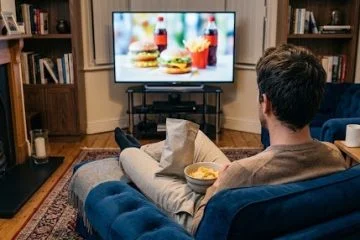
- On TV: six of the seven in-scope food ads it identified during the Britain’s Got Talent final would fail it too.
- Public opinion: 57% of UK adults think the Government should do more to restrict unhealthy food advertising aimed at children.
The OHA also argues that implementing the model would give responsible businesses “the stability and level playing field they’ve been asking for”.
What it means for marketers
Both sides want certainty. Right now, neither side has it.
That leaves brands and agencies planning 2027 activity without knowing which products will be in scope. A few things are worth doing now:
- Check your portfolio against both models. Know which products pass today but could fail the 2018 version, especially in categories like cakes, biscuits, desserts, cereals and yoghurts.
- Remember it’s not just advertising. The same model decides what can be promoted and where it can sit in store.
- Plan for flexibility. Build campaigns that can switch focus if the rules change at short notice.
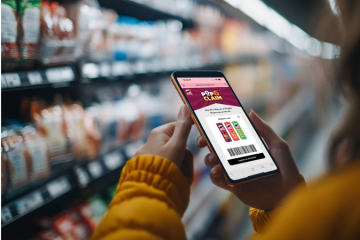
- Look at the levers that stay open. Single-purchase money-off coupons sit outside the volume promotion rules. For many brands, targeted coupons and rewards are becoming a bigger part of the mix.
- Watch the ASA. Its first rulings under the current restrictions are the clearest guide to how any future rules will be enforced.
Get the full picture
Join savi and the Institute of Promotional Marketing for a free webinar on where the rules stand, what the first rulings tell us and what could come next.
savi Academy x IPM | Navigating HFSS: Rules, Rulings & What’s Next
Tuesday 10 November | 10–11am | Zoom | Free
Samuel Winterbourne, Regulatory Affairs Manager at the IPM, will explain how legislation, the CAP Code and ASA enforcement fit together, which campaigns are most likely to fall foul, and how to build marketing that still lands. savi will share live data on how shoppers are responding to coupons and rewards.