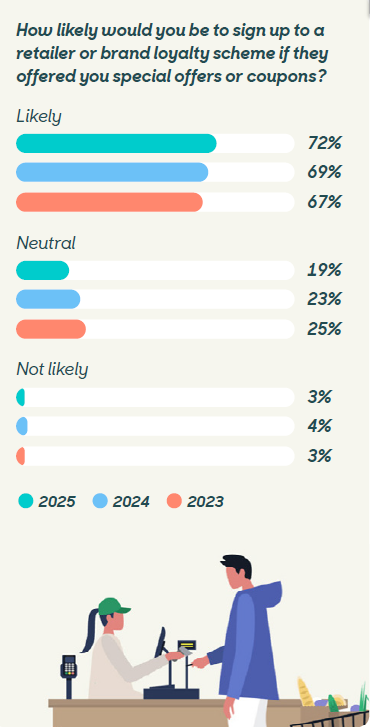
72% of UK shoppers will share personal data in exchange for a coupon – up from 67% in 2023. At a time when third-party cookies are disappearing and loyalty sign-up rates are flattening, that’s a number worth paying attention to.
The deprecation of third-party cookies has pushed FMCG brands to lean harder on CRM: more sign-up prompts, more loyalty programme pushes, more gated content. But in grocery, loyalty card data stays with the retailer. A brand selling across Tesco, Sainsbury’s, Morrisons and Co-op simultaneously doesn’t own any of it – they get aggregated, anonymised sales data at best.
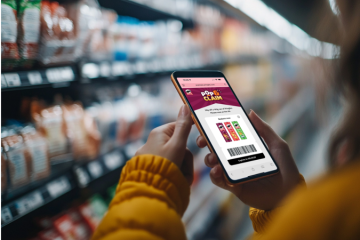
Mobile coupons sit in a different position. When a shopper activates an offer, that action generates a direct, brand-owned data event – a named, consented interaction linked to a specific product and a specific promotional moment. The coupon isn’t just a discount mechanic. It’s a data acquisition tool. And brands that haven’t recognised that shift are leaving clean, purchase-linked first-party data on the table. The question is: what are shoppers actually willing to give you?
What shoppers will and won’t share
The savi 2026 Shopper Report draws an important distinction that brands often miss. Shoppers aren’t universally open to sharing data — their willingness is conditional, and it varies significantly by data type.
When shoppers were asked what personal information they’d be comfortable sharing in exchange for a coupon, the pattern was consistent across age groups:
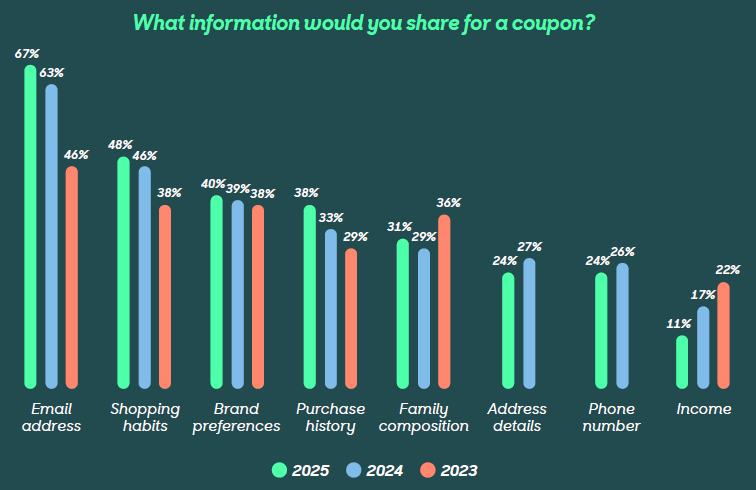
This matters for campaign design. Asking for an email address and postcode in exchange for 50p off a dairy product is a fair and accepted trade for the majority of shoppers. Asking for a phone number or income data is not – and will reduce both activation rates and brand perception.
The principle is proportionality: the data ask should be proportionate to the offer value, and the data type should feel relevant to the context. Shoppers are not naive about data exchange — they understand the transaction. They simply want it to feel reasonable.
The trust dynamic
One finding from the Shopper Report that deserves specific attention: trust in the brand matters more than trust in the retailer when shoppers are deciding whether to share data via a coupon mechanism.
This is counterintuitive for brands accustomed to relying on retailer reach. The shopper may discover the coupon via a retailer app, but their decision to share an email address is based on whether they trust the brand behind the offer — not the platform hosting it. For FMCG brands with strong consumer recognition, this is an advantage. For challenger brands or new products, it’s a variable worth testing before scaling.
From data capture to data use: closing the loop
Capturing first-party data is only useful if there’s a plan for what happens next. The most effective model treats coupon-captured data as the start of a sequenced journey: a post-redemption thank-you that reinforces the brand relationship; a follow-up offer targeted to what the shopper just bought; and — for brands building toward a loyalty mechanic — a warm lead who has already demonstrated purchase intent. The profile of a shopper who activates and redeems is also a clean input for lookalike audience modelling, more accurate than panel data and more actionable than demographic targeting. The campaign that looks like a discount mechanic is, if structured correctly, also a CRM acquisition tool and an audience modelling input.
First-party data from a mobile coupon campaign is not a byproduct – it’s a strategic output. The campaign that looks like a discount mechanic is, if structured correctly, also a CRM acquisition tool, a purchase validation system, and an audience modelling input.
The compliance angle
One practical note on GDPR: mobile coupon campaigns are inherently well-suited to compliant data collection. The activation moment is a natural consent checkpoint – the shopper is actively choosing to engage. A clear opt-in, a linked privacy notice, and an unsubscribe mechanism in follow-up communications covers the key requirements under UK GDPR. For brands working through agencies, clarify early who owns the data relationship with the shopper, and ensure the consent captured covers the intended use cases.
What this means in practice
The shift from third-party to first-party data isn’t a compliance problem. It’s a capability opportunity but only if brands are willing to think of promotional mechanics as data infrastructure, not just discount tools.
A mobile coupon campaign that captures email addresses, validates purchases, and tracks redemption behaviour across retailers is, in effect, building a clean first-party dataset with every activation. The cost of that data acquisition – the coupon face value, the platform fee, the distribution investment – is often comparable to or lower than equivalent CRM acquisition through other channels. And the data quality is higher, because it’s linked to a real purchase.
The brands that will have the clearest view of their shoppers in 2026 won’t be the ones with the biggest loyalty programmes – they’ll be the ones that were most disciplined about what they captured, and most intentional about what they did with it.
72% of shoppers will trade data for a coupon. The question is whether your next campaign is set up to collect it.
Frequently asked questions
What first-party data can a mobile coupon campaign collect?
A well-structured mobile coupon campaign generates data at two points. At activation: email address, device type, location, time of day, and the source channel (email, loyalty app, search, social). At redemption: confirmed purchase, retailer and store location, and time elapsed between activation and buying. Unlike loyalty card data — which stays with the retailer — this is owned directly by the brand running the campaign.
Are mobile coupon campaigns GDPR compliant?
Yes, when set up correctly. The coupon activation moment is a natural consent checkpoint — the shopper is actively choosing to engage with a brand offer. A clear opt-in, a linked privacy notice, and an unsubscribe mechanism in all follow-up communications satisfies the requirements for freely given, informed consent under UK GDPR. For brands working through agencies, it’s worth confirming early who owns the data relationship with the shopper and that the consent captured covers the intended use cases.
How do mobile coupons compare to loyalty programmes for first-party data?
Loyalty card data is owned by the retailer, not the brand. A brand selling across Tesco, Sainsbury’s and Morrisons cannot access or combine shopper data across those retailers — each loyalty programme is siloed. Mobile coupon campaigns generate direct, brand-owned data events tied to a verified purchase, regardless of which retailer the shopper used. For FMCG brands without their own loyalty programme, a mobile coupon campaign is often the most practical route to clean, consented, purchase-linked first-party data.
 Want to understand what data your mobile coupon campaigns are generating and what you could be doing with it?