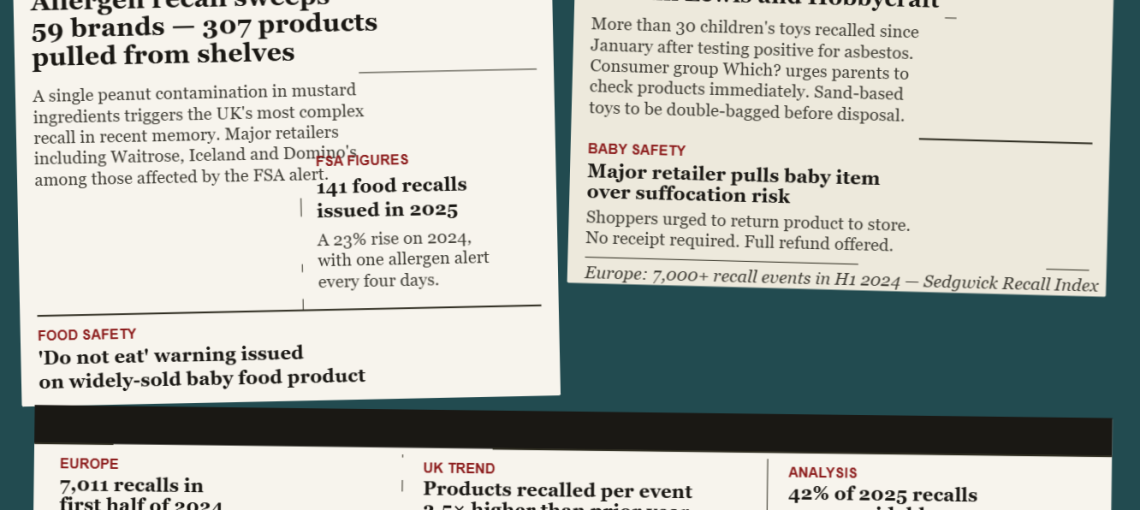
Product recalls are happening every single day – and across more categories than most teams expect. Today’s news cycle alone includes toys pulled from John Lewis and Hobbycraft after traces of asbestos were found, a baby item recalled by a major UK retailer over suffocation risk, and a baby food product withdrawn with a ‘do not eat’ warning. Which? has reported more than 30 toy recalls for asbestos since January.
In food, 141 recall notices were issued in the UK in 2025 – a 23% rise on the year before, with allergen alerts running at roughly one every four days. No category is immune, and the volume is only going one way.
The brands that come through a recall with their loyalty intact aren’t just the ones with the best crisis communications. They’re the ones where marketing and consumer care are aligned, equipped, and ready to respond as one. So what do those brands actually do differently?
The loyalty damage is bigger than it looks
Research from Harris Interactive found that 55% of consumers would temporarily switch brands following a recall – and 21% would avoid the manufacturer’s entire portfolio, not just the recalled product. That’s the number that should focus minds for brand teams: a single recall event can quietly erode equity across a whole range.
55% of consumers would temporarily switch brands after a recall. 21% would avoid all products from that manufacturer. Harris Interactive
But the same research points to something more useful: how much of that damage occurs depends almost entirely on how the recall is handled. Speed, transparency, and the quality of resolution are what consumers remember. A well-managed recall can actually strengthen trust. A slow or friction-heavy one compounds the original problem.
Where most brands fall short: the resolution gap
The standard recall resolution process – return the product, produce a receipt, wait for a refund – breaks down almost immediately in practice. Shoppers have often already consumed the product. They can’t find a receipt. They simply don’t have the time or inclination to go back to store.

The friction compounds the brand damage. And in an era where digital payments are instant, a slow manual returns process signals clearly that the brand hasn’t thought this through from the shopper’s perspective.
Our savi Shopper Report data shows that when shoppers experience a product problem, coupons and cashback rank among their preferred resolution mechanisms. A well-timed digital offer – issued quickly, without friction – can recover the relationship before the consumer has made a decision to walk.
The choice of mechanism matters too. A cashback payment compensates and closes the transaction. A coupon does something more valuable: it keeps the relationship active, giving the affected shopper a reason to come back rather than move to a competitor. For consumer care teams it’s a resolution tool. For marketing teams it’s a retention mechanism. Both outcomes from a single action.
How Carelink makes rapid resolution possible
savi’s Carelink platform is built for exactly this. When a recall situation hits, Carelink gives brands the ability to generate and distribute compensation at scale – in hours, not days – without requiring consumers to produce receipts or navigate a manual returns process.
Trained Care Agents work directly within the platform to issue cashback transfers in any denomination to a consumer’s account, or to distribute mobile coupons (or secure printed coupons where more appropriate) for use against a future purchase. The platform handles high volumes without manual workarounds, and operates globally – giving brands with international footprints consistent resolution standards across markets, with full audit trails for regulatory compliance.
Last year, savi powered more than half a million consumer claim reimbursements and resolutions through Carelink.
Is your team ready? Questions worth asking now
The brands with the best recall outcomes had a plan before anything went wrong. Consumer care readiness is rarely stress-tested – but it should be. These are the questions worth sitting down with now, before a crisis makes them urgent:
For brand and marketing teams:
→ Do you know how quickly your consumer care team can activate digital resolution at scale?
→ Is your crisis communications plan joined up with what the care team can actually deliver?
→ Are you using recall resolution as a loyalty mechanic – or just as a complaints process?
For consumer care teams:
→ Can you issue cashback or mobile coupons in hours, without requiring receipts or manual workarounds?
→ Do you have the platform infrastructure to handle high-volume claims digitally?
→ Are your agents briefed on the brand’s communications approach so resolution and messaging stay consistent?
With recalls running at record levels across food, toys, baby products and beyond, the question isn’t whether your brand could be affected. It’s whether both your teams will be ready when it is.
The brands that recover fastest are the ones where marketing and consumer care aren’t operating in parallel – they’re operating as one. Recall resolution handled well doesn’t just close a complaint. It demonstrates, in a moment that matters, that the brand genuinely puts the shopper first.
That doesn’t happen by accident. It happens because the right infrastructure – and the right plan – is already in place.
Want to know if your team is Carelink-ready?
Speak to the savi team about how Carelink supports rapid-response consumer care and product recall resolution or read more in our Lipton Case Study: