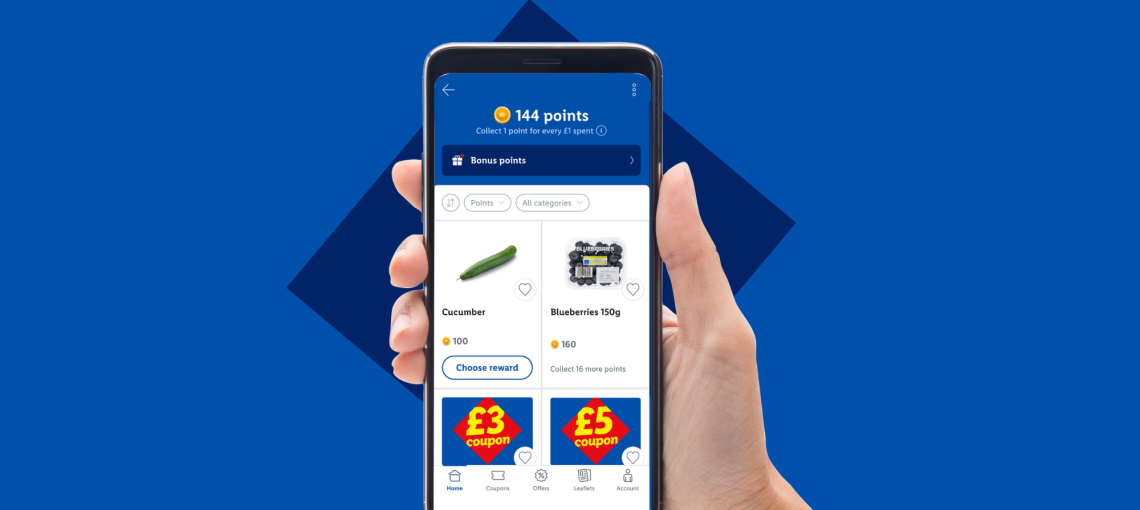
Millions of shoppers have reacted badly to Lidl’s revamped loyalty scheme. Our research shows exactly what they wanted instead – and why instant gratification beats points every time.
Lidl didn’t change its loyalty scheme quietly. The discount supermarket scrapped its longstanding system of free vegetables, pastries and spending-based rewards, replacing everything with a points model where value accumulates slowly over time.
The reaction was swift and largely negative. Reddit threads filled up. Facebook groups complained. Shoppers who’d built their monthly routines around a 10% discount voucher said they’d start switching to Aldi. One loyal customer of ten years described the original scheme as ‘a bit of an art’ – something she’d mastered, and was now losing.
For FMCG brands, this isn’t just a retail story. It’s a live experiment in shopper psychology.
The problem isn’t loyalty schemes. It’s deferred rewards.
The move to a points-based model makes strategic sense on paper. Lidl’s argument – that the new scheme lets customers ‘choose the rewards that suit them best’ – is reasonable in theory. But theory and shopper psychology aren’t the same thing.
Loyalty programmes are one of the most powerful tools in grocery retail. Done well, they drive frequency, increase basket size and generate the kind of first-party data that lets brands and retailers personalise at scale. The question isn’t whether to run a loyalty scheme – it’s what kind of value you put at the heart of it.
The smarter move – one that Tesco and Sainsbury’s have both made – is to anchor loyalty value in something immediate.
What Tesco and Sainsbury’s got right
Tesco’s Clubcard Prices and Sainsbury’s Nectar Prices both operate on a simple principle: being a member means paying less, right now, on products you’re buying today. No accumulation required. No conversion step. The reward is visible at the shelf edge and realised at the checkout.
Sainsbury’s CMO Pete Markey put it plainly when Nectar Prices launched: ‘It’s definitely all about that immediate benefit and value.’ That instinct – meeting shoppers where they are rather than making them wait – is what separates loyalty mechanics that build genuine habit from those that feel like admin.
Both schemes also layer personalised offers on top of their base pricing, targeting individual shoppers based on purchase history through their apps. That combination of immediate price benefit plus relevant, personalised offers is what modern loyalty looks like when it works.
Lidl’s old scheme had more in common with this model than its new one does. A free pastry after spending £10 in a month, or a 10% discount voucher after hitting a threshold, were concrete and near-term. The new points model moves in the opposite direction – toward abstraction and deferral, at exactly the moment when shoppers are least tolerant of both.
 What shoppers actually told us
The savi Shopper Report 2026 – based on a survey of 2,000 UK adults by OnePoll – gives us a precise picture of how British shoppers think about offers and loyalty mechanics right now.
73% of UK shoppers say coupons and offers influence their purchasing behaviour – up sharply from 54% just a few years ago. 54% say they would switch supermarket if a compelling offer was available elsewhere. Loyalty is a lot less sticky than retailers might hope.
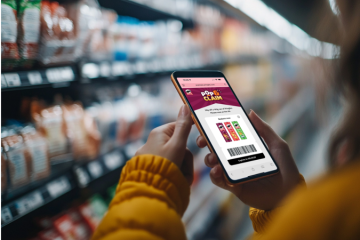
72% now redeem coupons via smartphone – in-store, at the point of decision. The expectation of mobile-first, frictionless value isn’t a preference. It’s the baseline.
Instant money off beats points. By 20 percentage points.
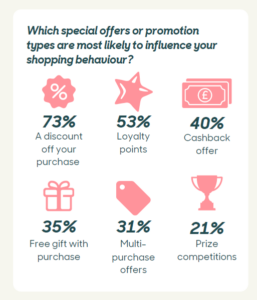
We asked 2,000 UK shoppers which promotions most influence their behaviour:
- Money off / direct discount: 73%
- Loyalty points: 53%
- Cashback: 40%
Direct money off outperforms loyalty points by 20 percentage points – a structural difference, not a marginal one. Tesco and Sainsbury’s have designed their schemes around the top of that list. Lidl’s new model sits firmly in the middle. That 20-point gap is the sound of Lidl’s members heading for the door.
The instant gratification gap
Shoppers consistently overvalue immediate rewards over future ones. A free pastry today is worth more, psychologically, than 50 points that might eventually become one. When the future value of a reward is unclear, shoppers rationally prefer the certain present value.

Mobile coupons are built around this insight. They deliver value at the exact moment it’s most welcome – at the shelf, at checkout, when the shopper is already in decision mode. 32% of shoppers say redeeming offers via smartphone improves their experience. Among 25 to 44 year olds – the most commercially valuable grocery cohort – that rises to 46%.
What this means for FMCG brands
It’s tempting to file a retailer loyalty story like this under ‘not our problem’. But two things happening here are very much your problem.
The first is shopper mobility. More than half of UK consumers would switch supermarket over the right offer – meaning your promotional strategy directly determines where your product gets purchased, not just whether it gets purchased.
The second is the data opportunity. 49% of shoppers discover coupons through email; 48% through loyalty apps. But what actually moves them to act is direct money off, not accumulated points. Brands that show up with clear, immediate value build a direct relationship with the shopper that doesn’t depend on any retailer’s loyalty mechanics.
That independence matters more than ever. Lidl’s loyalty scheme changed overnight. Brands that own their shopper relationship aren’t affected. Brands that relied on the retailer’s mechanic to create engagement are scrambling.
That’s why we’ve partnered with major loyalty apps to give brands instant reach – and developed more cost-effective loyalty solutions for brands who want to build direct relationships with shoppers without the overhead of a full programme. Whether you’re a challenger brand or an established name, there’s a model that works.
The lesson isn’t ‘don’t change’. It’s ‘know your value exchange’.
The backlash is a useful reminder: shoppers form habits around offers, build routines, and make switching decisions based on the quality of the value exchange on offer. When that exchange changes without warning and the replacement feels slower and less generous, they notice. And they move.
The brands that will win aren’t necessarily those with the most sophisticated loyalty programmes. They’re the ones who understand that the best loyalty mechanic is an offer the shopper actually wants, delivered at the moment they’re most receptive to it.
Want to see what our 2026 Shopper Report says about how your category’s customers respond to offers? Get in touch.
Based on research conducted by OnePoll on behalf of savi, surveying 2,000 UK adults in November-December 2025.